Commercial · Welland
Panic & Exit Hardware
The new access-control reader at the staff entrance works fine going in, but nobody has sorted out the door's exit side, and right now a card reader and a pushbar exist as two separate ideas.
Panic & Exit Hardware
In plain words
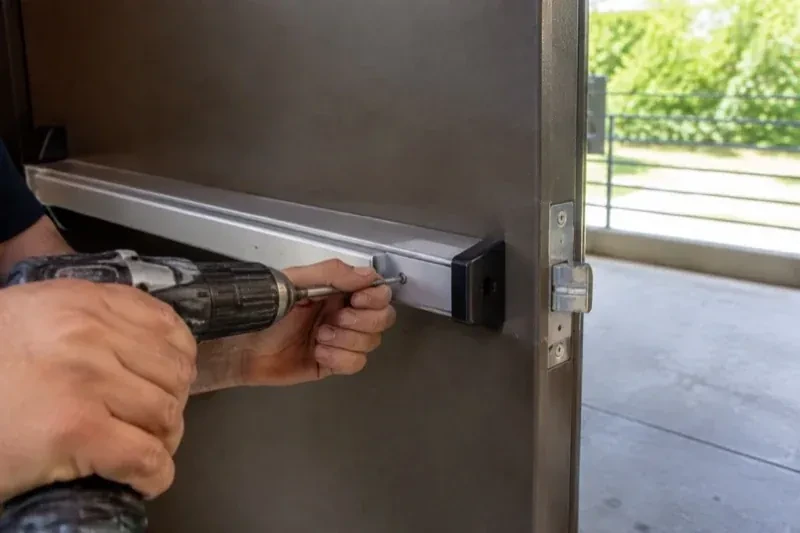
Panic and exit hardware installation fits a commercial door with a device that releases the latch the moment someone pushes on it from the inside, so the room's occupants are never asked to find a key to leave. The locksmith works from the room's occupancy and the door's fire rating first, then chooses a rim, mortise or vertical-rod device to suit the opening, pairs it with outside trim that still controls entry, and tests the release force and the latch before handing the door back. Any electrified addition, such as an alarm or a link to access control, is fitted once that basic function is confirmed.
How the visit goesThe new access-control reader at the staff entrance works fine going in, but nobody has sorted out the door's exit side, and right now a card reader and a pushbar exist as two separate ideas.
Welland
How the visit goes
Is this door part of a pair?
Single doors and pairs get assessed differently from the first look. On a pair, the locksmith checks whether a mullion currently splits the opening, whether a coordinator is already fitted, and whether the leaves close independently or in a set order. This decides whether the project is a straightforward device swap on each leaf or something larger, such as removing a mullion and fitting a compatible replacement latching arrangement to turn two narrow doors into one wide exit. Getting this right at the assessment stage avoids ordering hardware for a single door when the opening is really two leaves working together.
Mounting the device and fitting the strike
Installation follows the device's own template so every hole lands where the manufacturer intended, rather than adapting the door to a device that does not quite fit. Fasteners are chosen to match what the template and the door's own construction call for, and where the device specifies through-fixings, they run all the way through the door rather than biting into the surface alone. The strike is set and reinforced so it holds the latch securely under normal use. The crossbar or touchpad is aligned so it sits at a comfortable height and releases evenly across its width, not only at one end.
Staff who understand the dogging key
Whoever holds the dogging key or keyed dogging cylinder now knows what it does and, just as importantly, when not to use it: a door in a fire separation keeps its active latch at all times, so dogging belongs on openings where that restriction does not apply. Staff who prop doors for deliveries or busy periods have a legitimate tool for that instead of wedging the door with whatever is nearest, and the building keeps control over who can use it.
Panic & Exit Hardware
In the van
- Request-to-exit switch
- Through-fixings and mounting hardware
- Force gauge
- Signage and labels
- Outside trim (pull, lever or cylinder)
What affects the quote
Same fees day, night or weekend
1Removing hardware that should not remain
A padlock, hasp or extra deadbolt found on the door is removed and the resulting holes are filled or covered as part of the same visit, which is its own small task in the quote.
2Number of keys or dogging cylinders
Cutting keys for the outside trim and providing a dogging key or keyed dogging cylinder for the device is counted individually, the same way any keyed hardware is.
3Access to the opening
A ground-floor commercial door is straightforward to reach. An opening behind scaffolding, up a stairwell with no elevator, or in a space still under active construction takes longer to work at.
Panic & Exit Hardware: questions
What happens with a pair of doors instead of one?
It depends on the pair. Some latch independently and need nothing extra. Where the hardware calls for a set closing order, a coordinator lets the two leaves close in the right sequence, letting the active leaf's device seat properly into a strike carried on the inactive leaf, or into an astragal. Alternatively, the centre mullion can be removed and a vertical-rod device fitted to each leaf, turning the pair into one wide exit. Whichever applies, both leaves are tested working together, not one at a time.
How is occupant load actually counted for this decision?
Occupant load is calculated from the floor area and the intended use of the room, using published factors for that occupancy type, rather than a headcount taken on a busy night. A building official or a locksmith familiar with the calculation can work through it for a specific room, and the result is what decides whether the exit doors serving that room need a releasing device.
What is the difference between a rim, mortise and vertical-rod device?
A rim device sits on the surface of the door and suits most single openings, including many tall and fire-rated doors on their own. A mortise device fits into a pocket cut in the door's edge and is chosen where a heavier case or a particular trim style is wanted. A vertical-rod device runs rods to the top, or top and bottom, of the frame, which suits an opening that specifically needs latching at more than one point rather than height by itself.
Commercial Locks
- Master Key System DesignThe new wing was built with its own brand of cylinder, so the two-year-old keys from the original…
- Access Control InstallationHead office wants a record of who opens the branch and when, tied to an actual name rather than a…
- Commercial-Grade Lock ReplacementThe kitchen delivery door gets shouldered open more than a hundred times a shift, and lately the…
Panic & Exit Hardware near you
The lock services offered in Welland are grouped the way a door is used. Getting back in when you are locked out. Deciding who holds a working key. Upgrading the hardware so the door resists more than a casual try. Keeping commercial entrances working. Opening and maintaining safes. Each is described below.